What we learned:AI agents for IT service desks
What does it take to provide sustainable impact with an AI service desk agent? Lessons on process design, data management and the user journey.

· 9 min read
When we talk to people about classical IT service desk operations we find that everybody associates them with frustrating experiences of their own.
Avoidable frustration
The employee who can’t make progress: In many companies, requests can take a week or more to resolve on average, even when the actual work takes only a fraction of that time. Many report that you have to know whom to message privately or have your manager involved to get things moving faster.
On the other side, the stories of IT team members often sound like tales of frustration, too. Finding tickets you’re responsible for and forwarding others. The same repetitive questions already answered in the wiki - that nobody reads. Unspecified tickets without sufficient context that get returned to sender for clarification, substantially contributing to long resolution times.
IT leaders know these issues and would like to free up their team members to do more important work with their expertise instead of losing time on tasks they are overqualified for. But time spent keeping old processes running and fighting the fires they cause leaves too many organisations unable to improve them and reap the substantial and low-hanging fruits AI offers today.
The fruits are hanging low – in principle
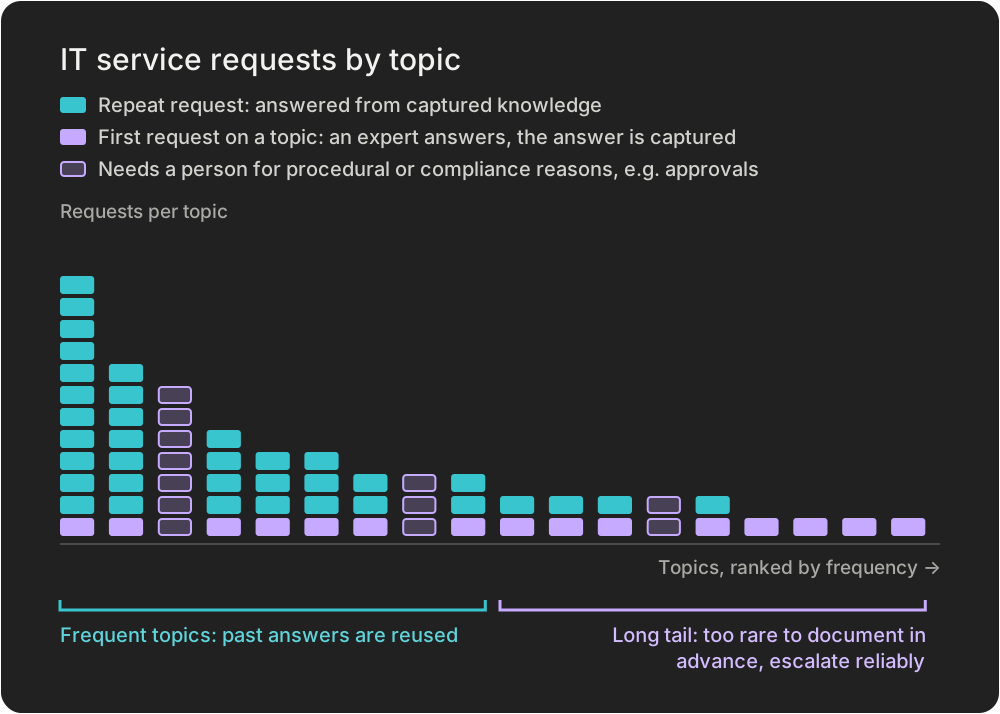
As is often the case in service, IT service desk tickets follow a so-called generalized Zipf distribution, where the most frequent topics make up the bulk of requests.
Frequently recurring topics include administrative issues, access, permissions and troubleshooting for systems and software, or ordering hardware.
That’s generally good news for AI agents, because it means many requests can be addressed with existing data.
Our analysis suggests around 50% of requests could be resolved immediately. And even where the others need a person for procedural reasons or the data is not quite sufficient yet, AI agents can very often help process them faster.
In practice, however, these gains can easily be missed if a couple of conceptual errors are not avoided.
The problem with data
A key problem many companies struggle with when introducing AI is their data – or more precisely, their perception of its state and how to deal with it effectively.
In the early days, many AI pilots failed because people just shipped them live without realizing that the wiki articles and FAQs they provided the AI agent with for context were insufficient or outdated knowledge sources. The knowledge is trapped in the heads of human operators instead. As a result many AI pilots based on this kind of data could only occasionally help users and very often misled users with hallucinations.
An AI agent, however, that does not help reliably and causes extra problems, does not get adopted sustainably and another failed AI pilot is put to rest.
Today, more teams understand that the state of their existing documents, wiki articles or FAQs is “not AI ready”.
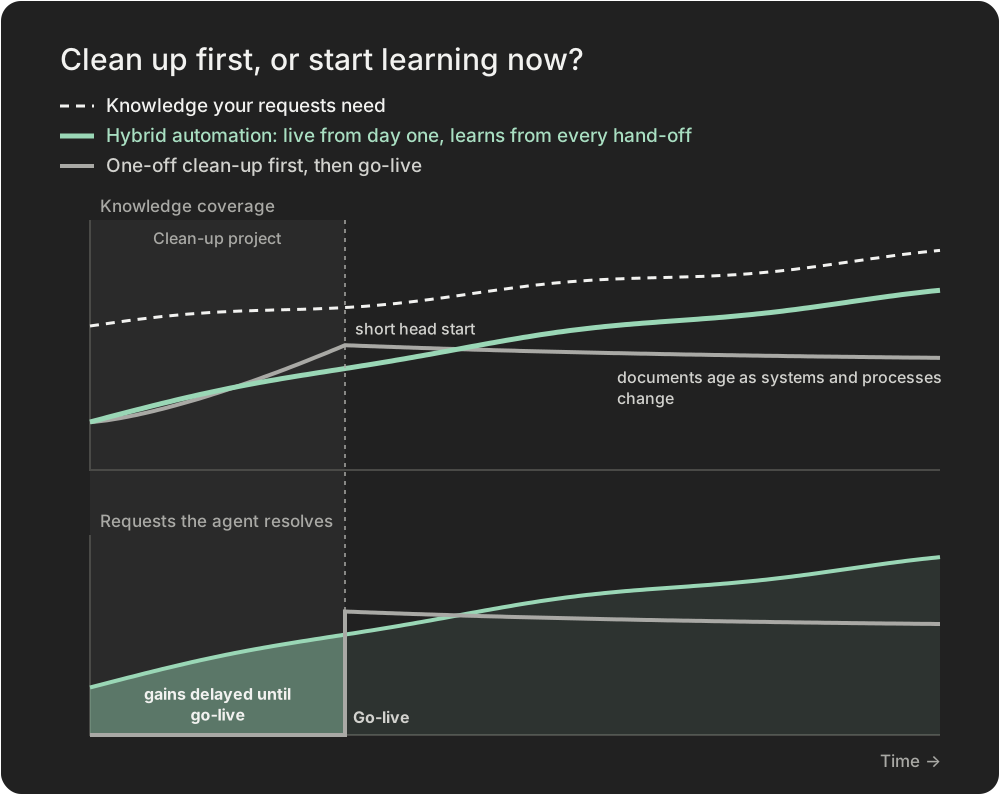
However, the conclusion drawn suddenly becomes the bottleneck. “We first need to get our data ready” is a misconception that creates the impression that the fruits are actually not hanging that low and hence the urgently needed AI transformation stalls.
However, there is no such thing as running a one-off data preparation project and then achieving “AI readiness”, as the needed knowledge is constantly evolving.
Knowledge maintenance that relies on manual work alone keeps failing because of the effort involved. While we always recommend investing a few hours or days to close obvious and highly relevant gaps, manual knowledge maintenance alone does not provide a sustainable strategic foundation to really reap the benefits of AI agents in the IT service desk.
And hence we need a different approach with the right recipe.
The recipe to strategically overcome limitations
1. Make better use of what is available
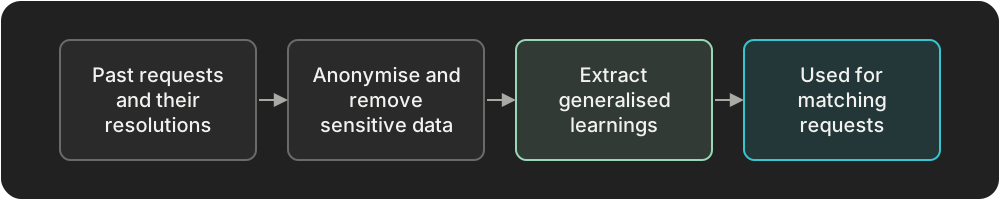
In our experience, most useful knowledge to answer IT service requests that is available as data is not contained in those sources that require active human maintenance such as wikis or FAQs. It is contained in digital artefacts associated with historic requests.
However, as these are protected by access permission boundaries and can contain sensitive and personal information a careful solution design is required to use such data compliantly.
We built a multi-layered knowledge extraction pipeline that first ensures historic requests are anonymised and cleaned from sensitive and personal information. A second layer then extracts only the abstract and generalised learnings from the cleaned historic cases. This limits what reaches the agent to generalised learnings, with sensitive information filtered out.
It took us quite a bit to get there, but it’s well worth it. It turns out this extracted knowledge is used more frequently by these kinds of AI agents in practice than the knowledge from manually maintained sources if the latter is not at a really polished state.
2. Leverage general IT knowledge of AI models
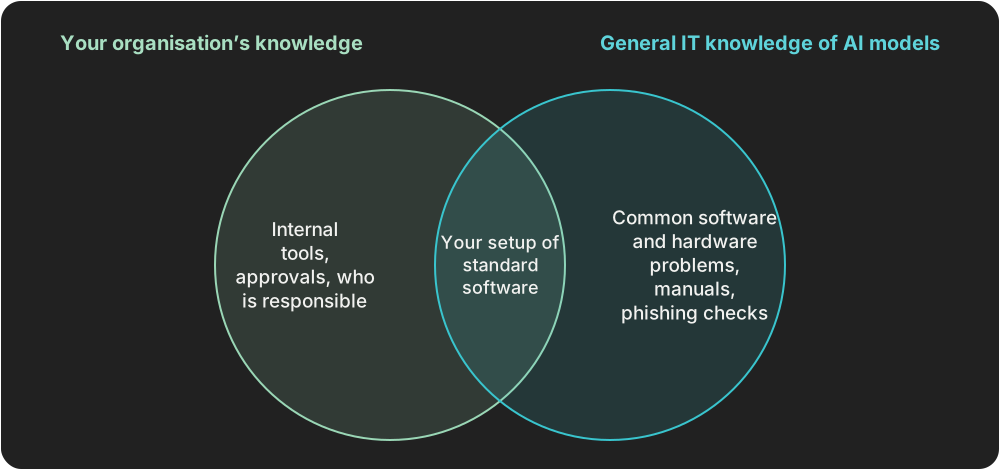
We also found that the general IT knowledge of AI models can provide service improvements to a substantial number of requests even if the available data does not provide guidance.
Many troubleshooting requests are common problems with software and hardware that are not organisation specific and an AI agent that can look up manuals can often help much faster than a human operator.
The same general knowledge helps with security, too. AI agents can boost an organisation’s resilience against phishing and provide employees with fast feedback and instructions on what to do and not to do. The more conveniently I can get my e-mails checked, the likelier it is that I am going to avoid falling into traps.
3. Make sources transparent and answers trustworthy
One of the key misconceptions I encounter when talking to stakeholders is comparing AI agents one-to-one with humans, assuming they should automate everything humans can do. But your data, general AI limitations and procedural requirements make that the recipe for failure.
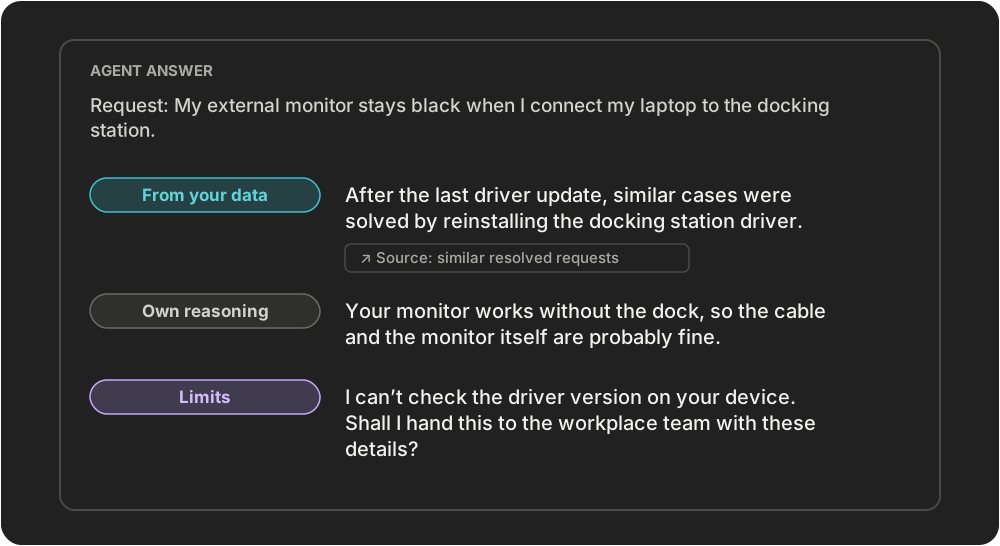
For your AI agents to cause fewer problems than they solve and users to trust and adopt them reliably, you have to make limitations transparent and should not try to hide them.
Our agents transparently separate what they found in data and what they infer from their own reasoning. They provide sources for the human to validate. And they clearly state the limitations of the evidence and what they can do.
4. Avoid the roadblock and handle the limitations
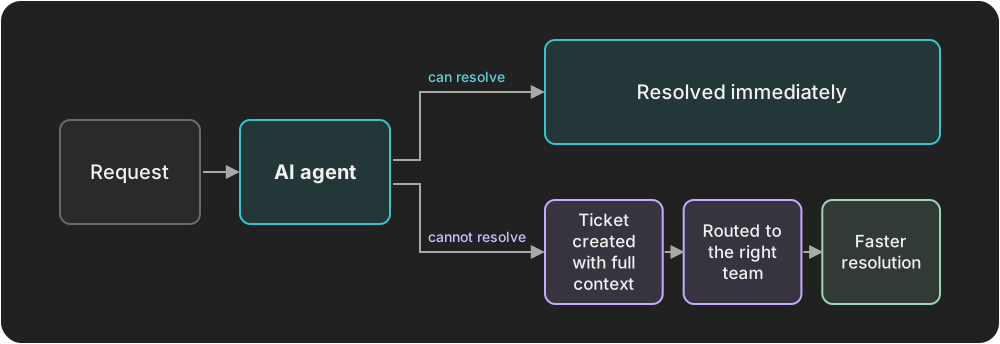
When the AI agent hits a roadblock in helping with a request it should not only avoid pretending to be able to skip past it, but it should also avoid leaving the user at a roadblock.
If I fail to get my resolution from the AI agent and have to go back to the classical IT request portal, how likely am I to try the AI agent again next time?
If instead the AI agent is able to create a new ticket for me and assigns it to the right IT team (or member) I am a much happier user.
I have gotten first feedback immediately, I have saved time creating a request and the request already contains all the required context. And as it is automatically handed off to the right people I’ll also get my resolution much faster. Of course I am coming back.
And that does not even mention how much happier the IT team members are with this change.
5. A system built to self-improve
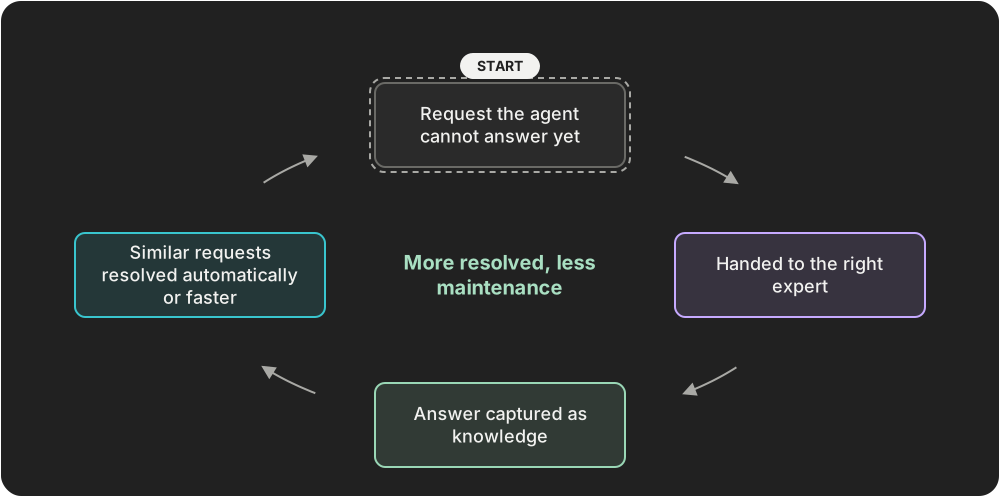
The best part of the overall setup? It is built to self-improve and evolve hand in hand with the organisation.
When requests for which data is lacking are forwarded to the right people, the relevant knowledge hidden in their heads gets acquired, preserved and natively stored in a way optimized for AI.
As the system captures knowledge that was previously missing, it can resolve more requests automatically and free up more time. At the same time, it evolves with the organisation, keeping that knowledge useful as requirements change and sustaining productivity gains with less manual maintenance.
One of the most important assets for the AI era is preserved along the way, laying the foundation for further productivity gains.
It does not mean employees cannot or should not actively document what they can anticipate to be important - simply write a quick note for AI. But it avoids relying on a classical notion of knowledge management that has proven to fail for decades.
The outcomes of “Hybrid Automation”
We call this strategic approach hybrid automation and use it to increase productivity across the entire process.
- It maxes out what AI can resolve immediately.
- Instead of discarding partial automation opportunities, it captures them.
- It seamlessly integrates the AI workflow into the human workflow.
- It reduces the upfront overhead and reaps the benefits much faster.
- It improves user adoption so the benefits can really play out.
- It self-improves and evolves with evolving requirements.
- It sets the strategic foundation to reap even more gains for future AI model capabilities and use cases.
How you reap those benefits then really comes down to your own setup. Some get rid of outsourced first-level dispatch services, some get more productive and others can save the costs of restaffing or expanding their IT teams.
Interested in what this could mean for your IT service desk?
or email [email protected]